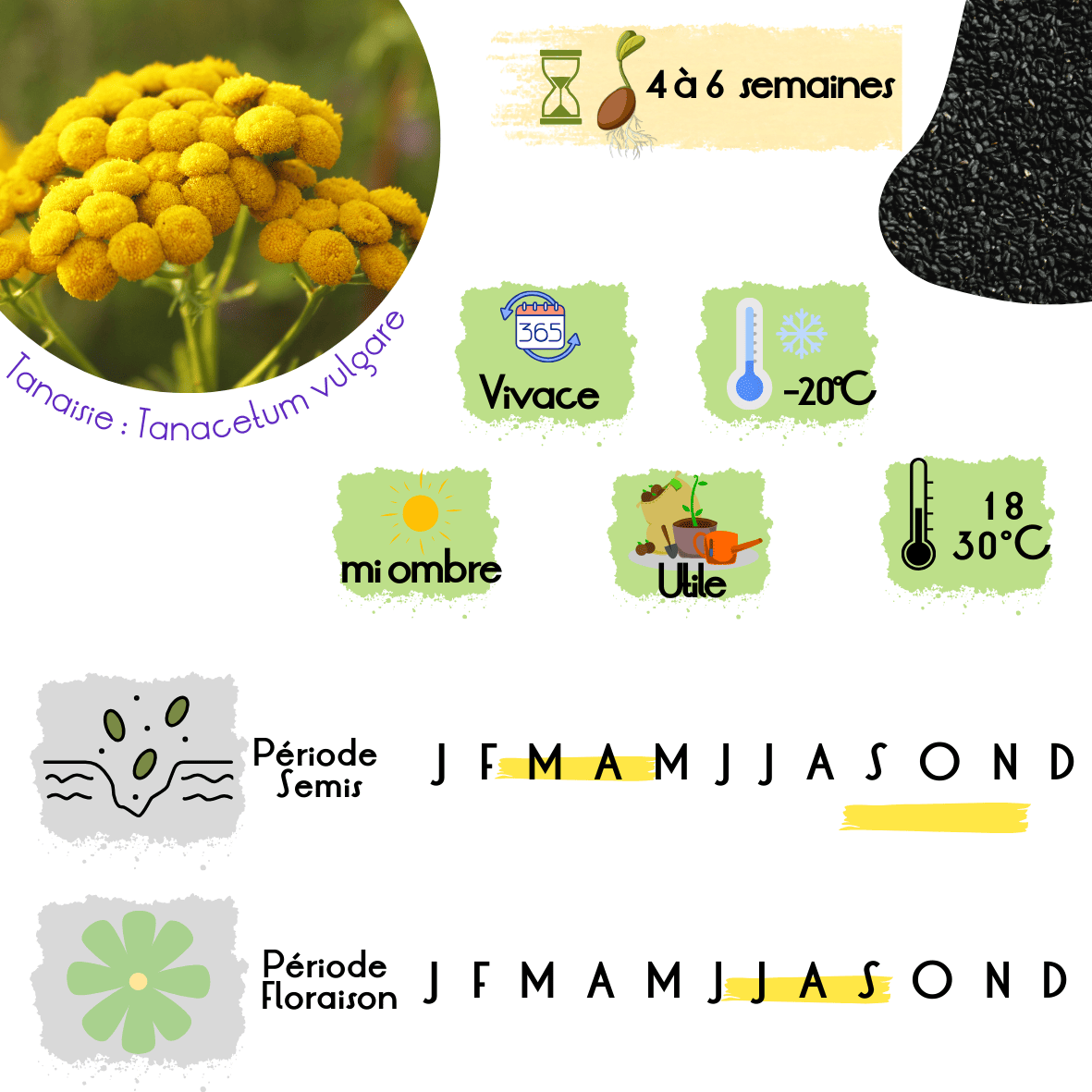


Tansy (Tanacetum vulgare) - seeds
Tansy (Tanacetum vulgare) - seeds
Tansy (Tanacetum vulgare): seeds of a perennial in the Asteraceae family, with finely divided, highly aromatic foliage and flat, petal-less golden-yellow flower heads gathered in broad corymbs. It is a plant of banks, waste ground and roadsides, growing wild throughout Europe, which settles in without any attention.
Couldn't load pickup availability
Expédié depuis le Jura - Paiement sécurisé - Retrait possible à Francheville
What you receive
What you receive
A 1 gram packet, about 1,000 seeds. They are tiny: sow them from a folded sheet of paper, as with other Asteraceae seeds.
Sowing
Sowing
Sow in spring on the surface, without covering, or directly in place in autumn. Press the seeds onto a fine substrate and keep moist with a fine spray, at 15 to 20 °C. Germination takes two to three weeks. Prick out at the two true leaf stage, then plant out 50 cm apart in all directions.
It accepts almost any soil, from sandy to heavy, and prefers full sun. Once established, it needs no soil improvement, no regular watering and no particular care.
The mature plant
The mature plant
An upright clump 60 cm to 1.20 m tall, with stiff, often reddish stems, bearing dozens of small, flat yellow buttons from July to September. The crushed foliage gives off a powerful camphor scent, somewhere between wormwood and chrysanthemum.
Fully hardy, it comes through Jura winters without protection and regrows from the base every spring.
It spreads: plan for it
It spreads: plan for it
Tansy spreads by creeping rhizomes and self-seeds. In good soil, one clump becomes a colony in three or four years. This is not a drawback if you intend it for a bank, a wild border or the back of the garden, but give it a spot where its spread will not bother you, or grow it in a large pot. Cutting the flowers before they set seed solves half the problem; the other half is solved with a spade.
For insects
For insects
Its flat corymbs make ideal landing strips for small short-tongued insects, hoverflies, ladybirds and micro-wasps, which struggle to find food on deep flowers. That is why it has its place in a garden managed for biodiversity.
Collector's seeds
Collector's seeds
These seeds are sold as ornamental and botanical collector's seeds. Tansy contains thujone, the same molecule as wormwood, and is not an edible plant: we provide no dosage, no preparation method and no expected effect, and we do not offer it as an ingredient for consumption. Wear gloves if you handle large quantities, and wash your hands afterwards.
Frequently asked questions
Frequently asked questions
Is it an insect repellent?
That is its long-standing reputation in gardens, and many gardeners make a fermented plant extract from it. We do not sell it for that use: advertising of plant protection products is regulated, so we make no claim of effectiveness of that kind. What we describe here is a hardy ornamental perennial.
What is the difference from feverfew?
Feverfew (Tanacetum parthenium) belongs to the same genus, but its flowers have white petals around the yellow centre and its foliage is broader and light green. Tansy has no petals at all: its flowers look like chamomile flowers with the outer ring removed.
Why not cover the seeds?
Because they are very small and germinate on the surface. Seeds buried deeper than a few millimetres largely fail to come up.
Does it flower in the first year?
Rarely. A spring sowing gives a clump of leaves in the first season and flowers in the second. An autumn sowing gets a little ahead.
Also worth exploring: wormwood, another bitter, camphor-scented member of the Asteraceae, mountain arnica, and our full range of seeds from around the world.