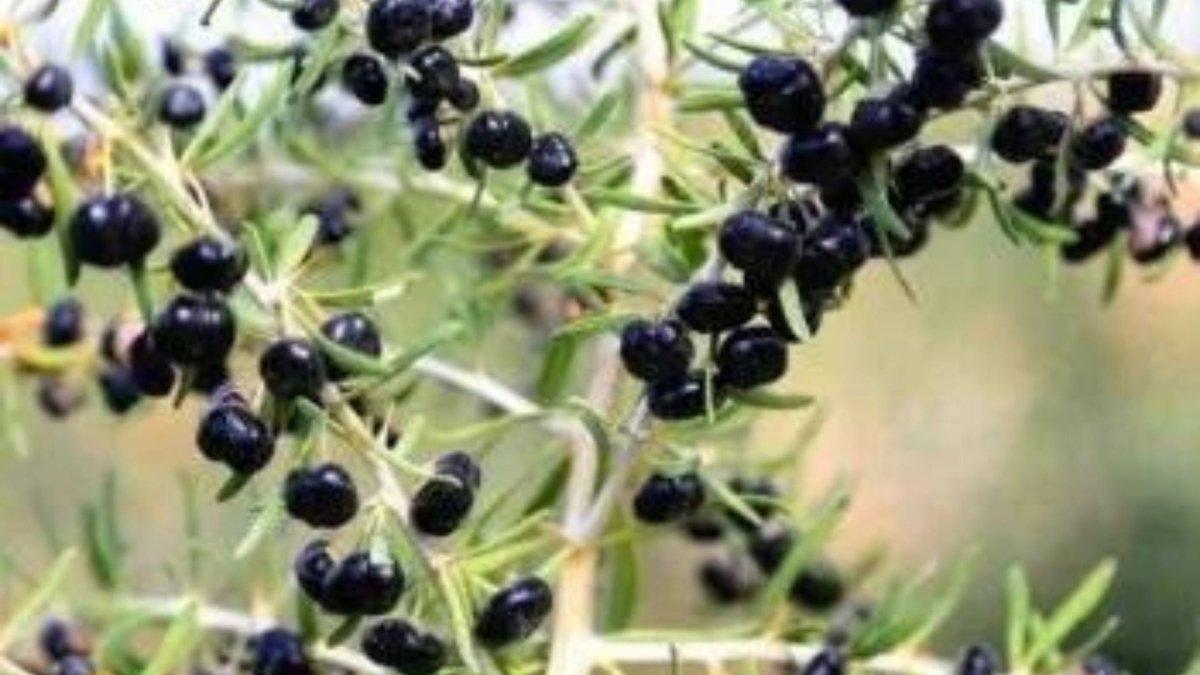


Black goji (Lycium ruthenicum) - seeds
Black goji (Lycium ruthenicum) - seeds
Black goji (Lycium ruthenicum): seeds of a member of the Solanaceae from the salt steppes and cold deserts of Central Asia, from Xinjiang to Qinghai and Tibet. It is a species distinct from red goji, rarer and more austere.
Couldn't load pickup availability
Expédié depuis le Jura - Paiement sécurisé - Retrait possible à Francheville
What you receive
What you receive
A packet of 10 seeds of Lycium ruthenicum, extracted from ripe berries.
Sowing
Sowing
Sow in spring under 2 to 3 mm of fine compost, at 18 to 22 °C, keeping moist but not waterlogged. Germination takes two to four weeks and is more irregular than with red goji: this is normal for a species from an extreme environment, whose seeds do not all germinate in the same year.
Prick out into deep pots once two true leaves appear. In the ground, give it full sun and a very free-draining, poor, rather alkaline soil. Rich, moist soils do not suit it.
The mature shrub
The mature shrub
A dense, twisted bush of 50 cm to 1.50 m, markedly thornier than red goji, with whitish stems and small, fleshy grey-green leaves, almost succulent. The flowers are small and dark violet, followed by spherical black berries the size of a small pea, glossy, ripening in late summer.
It is extremely tough: severe cold, drought, wind, and above all saline soils, where it grows where almost nothing else takes hold. It is a plant of difficult environments, which does better in a harsh spot than with too much comfort.
The berries
The berries
Their deep black colour comes from anthocyanins, the same pigments as in blueberries or blackcurrants, here in high concentration: crushed in a little water, a single berry turns the liquid an intense violet, and the shade turns pink in acidic conditions and blue in alkaline conditions. In China, they are consumed dried, most often as an infusion, and sell for far more than the red ones.
Frequently asked questions
Frequently asked questions
Does it taste the same as red goji?
No. It is less sweet, more vegetal and slightly astringent. It is drunk more than eaten.
Is it as productive?
No, it yields much less and later. It is a collector's plant before being a productive one.
Is it cold-hardy?
Very, it comes from regions with harsh winters. What kills it here is winter wet in heavy soil, not the thermometer.
Are the thorns a nuisance?
Yes, they are fine, long and sharp. Wear gloves for harvesting and avoid planting it next to paths.
Also worth exploring: red goji, easier and more productive, and our full range of seeds from around the world.